


A few months ago, I wrote about being partway through the B Corp assessment, committed to it, but honestly, a bit unsure whether the effort would justify itself for a small team like ours.
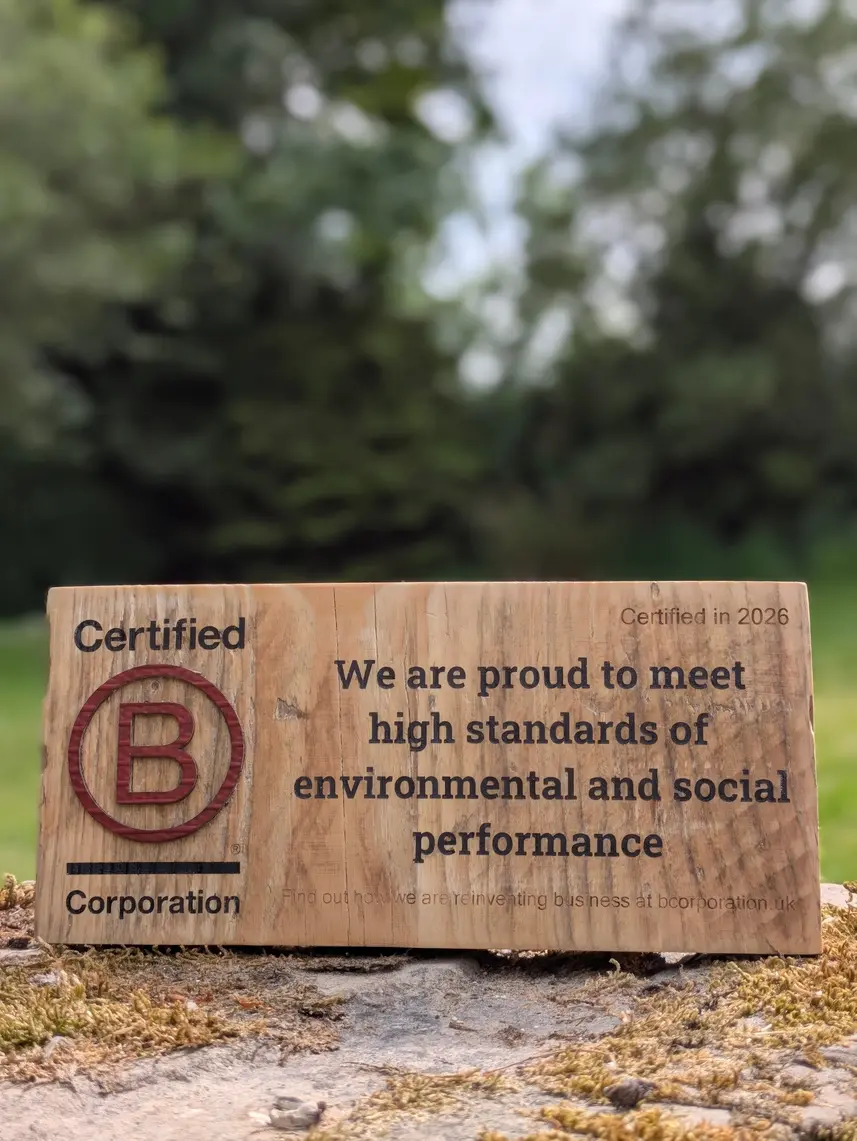
The short story is, it did! We’re now officially certified 🎉
The longer story is about how the process actually helped us, and what it means for the work we do going forward.
Good stuff was happening, but it wasn’t written down.
Permalink to "Good stuff was happening, but it wasn’t written down." headingWhen you’re a small team, expectations get understood without needing a handbook. Everyone knows what good looks like because we’ve been doing it together for years. Policies, processes, the way we make decisions: it all lives in conversations and shared assumptions.
The assessment didn’t ask us to change how we work. It asked us to evidence it. That meant taking things that were clear to us internally but vague on paper, and bringing them up to a level of detail where someone outside the company could read them and understand exactly what we do and why.
The documentation work felt like busywork for about a day. After that, it started to feel like something else.
Putting it in black and white made us feel more grounded.
Permalink to "Putting it in black and white made us feel more grounded." headingWriting things down forces you to make decisions you’ve been quietly dodging. Who’s actually responsible for this? What’s our policy if that happens? What do we mean when we say we care about a particular thing?
A lot of those answers had been understood rather than written. Pulling them out of our brains and committing them to a page made the company feel more solid. Each of us came out of it clearer on where our responsibility sits and how the everything fits together. That sounds dulln practice, it was quietly confidence-building.
B Corp values aren’t new. We’ve always cared.
Permalink to "B Corp values aren’t new. We’ve always cared." headingThis was the part that surprised us most. The criteria B Corp assesses (how you treat people, how you affect the environment, whether you’re using your work for something worthwhile) map closely onto how we already approach client projects.
Our company’s goal has always been to make better software. That short phrase shapes a lot of how we work. It keeps us focused on the people who’ll actually use what we build, and on the details that matter to them: whether the interface is accessible, whether the design respects them, and whether they’ll be able to use it in a real-world context.
It also keeps us focused on time itself, ours and our clients’. Time is what we trade for outcomes, so wasting it on the wrong work is the worst thing we can do. Every project is a chance to understand a problem and create a better solution.
The discipline of doing that consistently, looking for what’s within reach, putting effort into details, working productively with the people around you, turns out to be the same discipline B Corp is trying to recognise. It’s not a separate values exercise sitting next to the work. It happens through the work.
A milestone, not the end.
Permalink to "A milestone, not the end." headingBecoming a B Corp is a proud moment for our team. But it’s not a finish line. We’ve always been pointed in this direction, and the certification gives us more focus on where we’re going and what we want to be accountable for.
As part of that, we’ll be publishing our commitments on our site. Each one will have its own page: how we look after the team, how we work with clients, how we approach AI, what we give back, our environmental policy, and more.
Some of these are practices we’ve been running for years, like our 1% for the Planet membership (since 2019). Others are newer, like our matching 1% for social causes which we started in 2025. All of them are now in writing, with the reasoning behind them, so anyone considering working with us can see exactly what we stand for.
For us, the point of certification isn’t the badge; it’s the discipline of being focused on a purpose. Alongside the commitments, we’ll publish an annual impact report to summarise the progress we’ve made towards our goals. Sharing that in public is what keeps us honest.
The work that matters most.
Permalink to "The work that matters most." headingOur team’s well-being, our policies, and our internal handbook all matter, but the greater impact comes from our work with organisations.
We build and maintain the tools and services that millions of people rely on. That work is never finished.
There’s always a way to make a piece of software more usable, more efficient, and more respectful of the person using it. That’s where we have an ongoing responsibility, and the opportunity to make a difference by delivering these important (but often forgotten) qualities.
- Accessibility as a default, not a feature. Interfaces that meet WCAG, work with assistive tech, and don’t fall apart at 200% zoom. We’d rather catch this in design than retrofit it after launch.
- Calling out unethical patterns. Dark patterns, manipulative copy, sneaky defaults, addictive loops. If we spot something bad for the end user, we’ll say so, even when it might convert better in the short term.
- Data security and integrity. Collecting what’s needed and nothing more. Being clear with users about what’s held, why, and how to get rid of it. Treating data decisions as design decisions.
- Content that respects the reader. Plain English over jargon. Avoiding the negative framing and anxious language that creeps into a lot of digital products. Writing for people with low numeracy or limited time, not just confident users with a quiet hour.
- Performance as an environmental choice. Lighter pages, fewer requests, less wasted compute. It’s better for users on slow connections and older devices, and it reduces the carbon footprint of the internet.
- Long-term thinking over short-term optics. Building things that hold up, choosing dependencies we’ll still trust in two years, writing code the next person can read.
We realise we’re not the only ones doing this.
Permalink to "We realise we’re not the only ones doing this." headingOther software companies are applying the same care, and plenty of them have been at it longer than we have. We’re glad to be in that group, and we’d like it to keep growing. The more of us putting this kind of thinking into how software gets made, the better the software gets.